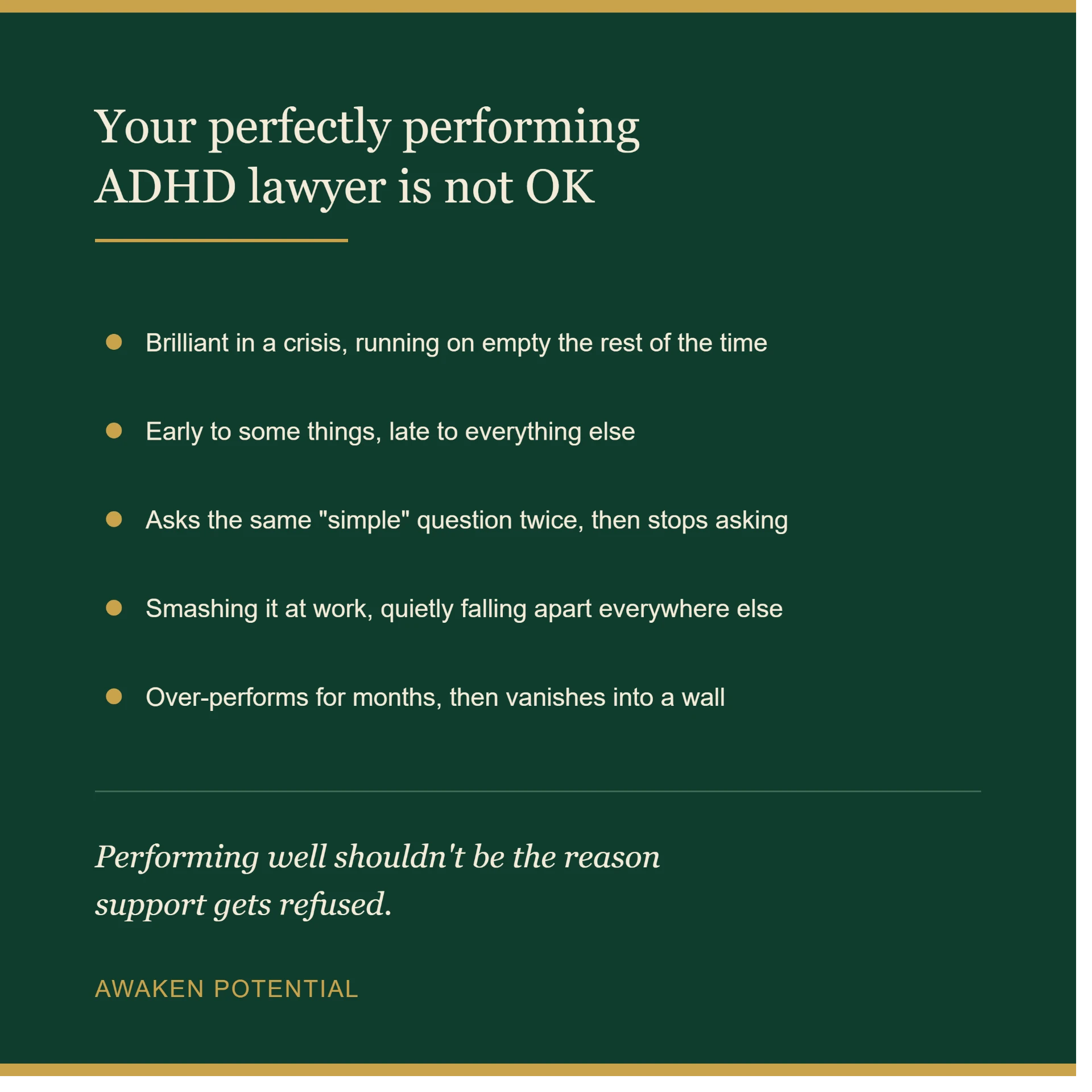
Your perfectly performing ADHD lawyer is not OK
Yes, they're hitting targets, delivering excellent work and staying on top of deadlines.
I'm sure they even have colour-coded Outlook calendars, detailed reminder notifications, chargeable time and pipeline projections.
The image of pure perfection.
The quality of their legal work is no doubt excellent.
Their extensive organisational tools are also incredible.
But this all comes at a cost.
They don't look like they're struggling. That's because they are masking — whether they realise it or not.
That's exactly the problem. Because living like this is not sustainable. Even if burnout eventually forces a stop, the body has kept the score and some of the damage is not repairable.
Here's how to actually spot an ADHD lawyer:
- They're brilliant in a crisis, but running on empty the rest of the time
- They're early to some things, late to others — never on time
- They ask the same "simple" question more than once, then stop asking
- They're smashing it at work and quietly falling apart everywhere else
- They over-perform for months, then vanish into a wall
Great news is, small low or no cost changes can allow the excellent performance to continue, but without the cost to the ADHD lawyer.
Many ADHD lawyers have spent a lifetime adjusting themselves to fit in, many to the extent that they don't even realise they are doing it.
For many, struggle has been such a constant theme in their lives for so long that they could be close to the edge and not even know it.
So when someone discloses ADHD, it's not a chance to say "wow, your superpowers!" and move on.
It's an SOS.
Ignoring it because they "look fine" is the fastest route to burnout — and when a brilliant lawyer burns out, nobody wins.
Employers: disclosure is a request for proactive support, not proof none is needed.
ADHDers: it's okay to say, "I want support, I'm just not sure what that looks like yet — can we figure it out together?"
Performing well shouldn't be the reason to refuse support.